International Collaborations

Staff Mobility

Global Educational Exchange Sparks New Vision for Human-AI Symbiosis: PubCirEco Conference in Vilnius, Lithuania - December 2025

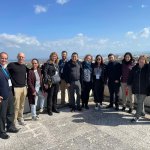
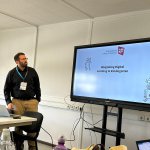
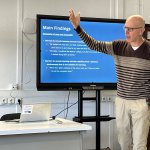
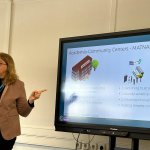
In December 2025, Mykolas Romeris University (MRU) in Vilnius, Lithuania, hosted a high-level intensive training event for the PubCirEco project, a global initiative led by Professor Birutė Mockevičienė that brought together international experts and students from nine countries to advance circular economy practices and innovative, problem-based learning.

Our very own Dr. Ilan Bar Shalom returned from the PubCirEco conference, bringing back a unique framework for integrating Artificial Intelligence (AI) into the modern classroom. The mission, which included collaborations with Professor Birute and presentations at MRU, focused on a critical global challenge: ensuring that AI serves to amplify, rather than replace, human intelligence.

Addressing the “Cognitive Deficit”

A central theme of the visit was the risk of “cognitive debt,” a decline in critical thinking and problem-solving caused by an over-reliance on generative AI. Dr. Bar Shalom’s report highlights that unregulated use can lead to “self-deception,” where students bypass deep learning processes.

To counter this, the faculty proposes a “human-in-the-loop” approach that transforms the educator’s role from a knowledge disseminator to a mentor and facilitator. By automating administrative tasks, AI could save teachers up to six hours weekly, allowing them to focus on the socio-emotional growth of their students.

The Pedagogical Toolkit

The exchange showcased a robust, integrated toolkit designed to be used within immersive environments like Eureka Worlds. This model rests on four pillars:

Self-Determination Theory (SDT): Fostering student autonomy and competence.

4C Skills: Directing AI use toward Communication, Critical Thinking, Collaboration, and Creativity.

Self-Regulated Learning (SRL): Implementing digital dashboards to monitor and plan the learning journey.

  • Phenomenological Reflection: Using van Manen’s methods to help students honestly assess their original contributions versus AI assistance.

Real-World Success Stories

The visit highlighted practical applications in Israeli high schools that serve as global models for innovation:

  • Katzir Gymnasium: (led by both Dr. Bar Shalom and Dr. Jossef Schwartz, faculty members at the M.Ed School at Kaye College) 7th and 8th-grade students launched virtual startups, using AI as a partner for market analysis while maintaining creative control over their brand designs.
  • Abu Tlul High School: 9th-grade students in the Bedouin community built virtual museums to share local challenges, demonstrating high levels of independent learning and social collaboration.
  • International Connection: A collaborative session even linked students from Israel and Ukraine, fostering deep engagement and shared problem-solving through the “Problem-Based Learning” (PBL) approach.

A Call for AI Literacy

Dr. Bar Shalom argues that the future of education depends on a “human-AI symbiosis”. However, he warns of a persistent “digital divide,” calling for mandatory AI literacy training to ensure that all educators and students can navigate this new frontier in an equitable manner.

"May 2025 "A Bridge to Digital Literacy: Entrepreneurship and Innovation in the Bedouin Sector

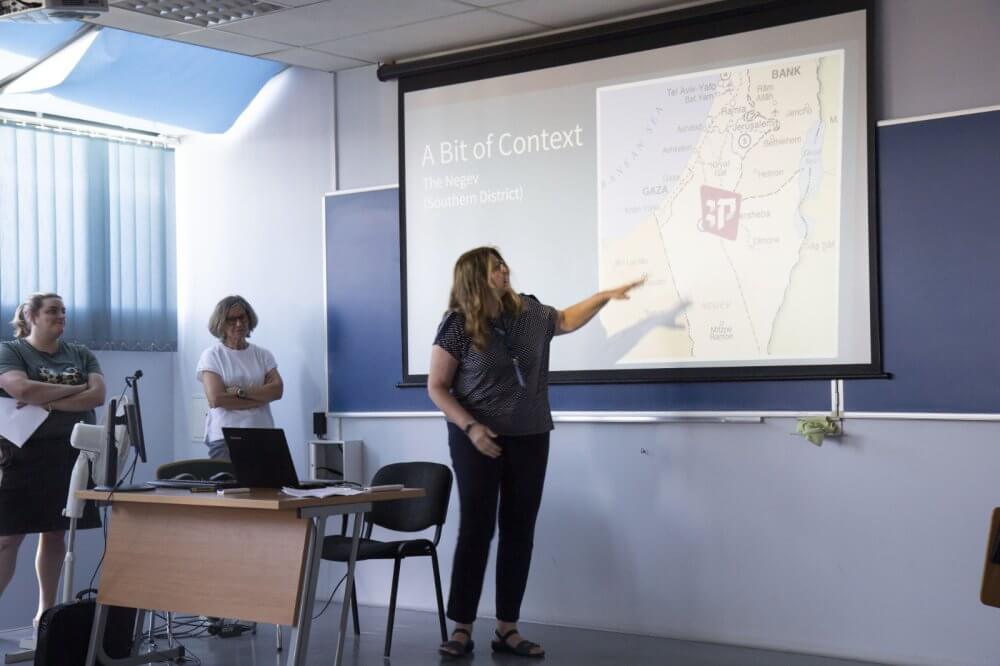
On Tuesday, May 13, 2025, a captivating and well-attended study day titled “A Bridge to Digital Literacy: Entrepreneurship and Innovation in the Bedouin Sector” was held at the innovative XLabs complex at Sapir Academic College. This event, which marked a significant milestone, brought together academics, students, local authority officials, teachers, entrepreneurs, representatives from government ministries, private entities, foundations, and numerous stakeholders. All were united by the common goal of promoting digital literacy, entrepreneurship, and technological innovation within the Bedouin sector. This initiative is an integral part of the international VOLCANIC project (Israel, Morocco, Europe), a collaborative effort involving the MOFET Institute, Kaye College, and Sapir College in Israel, focusing on reducing digital disparities, with a particular emphasis on the Bedouin sector and geographically remote populations.

The day commenced with a thought-provoking expert panel on “Digital Gaps in Israel: Challenges and Opportunities in the Bedouin Sector.” The highlight of the study day was an in-depth look at the unique and innovative courses developed within the Volcanic project. Participants gained insights into content that integrates entrepreneurship and innovation, as well as practical methods for promoting meaningful learning through technology. Models and tools designed to equip participants with the essential skills for the digital age were also presented.

Following a light lunch and a productive networking session, attendees had the opportunity to “hear firsthand” – a direct engagement with students and teachers who had participated in the project’s various courses. They shared their experiences, insights from collaborative learning, and the program’s impact on their professional and personal development.

On Tuesday, May 13, 2025, a captivating and well-attended study day titled “A Bridge to Digital Literacy: Entrepreneurship and Innovation in the Bedouin Sector” was held at the innovative XLabs complex at Sapir Academic College. This event, which marked a significant milestone, brought together academics, students, local authority officials, teachers, entrepreneurs, representatives from government ministries, private entities, foundations, and numerous stakeholders. All were united by the common goal of promoting digital literacy, entrepreneurship, and technological innovation within the Bedouin sector. This initiative is an integral part of the international VOLCANIC project (Israel, Morocco, Europe), a collaborative effort involving the MOFET Institute, Kaye College, and Sapir College in Israel, focusing on reducing digital disparities, with a particular emphasis on the Bedouin sector and geographically remote populations.

The day commenced with a thought-provoking expert panel on “Digital Gaps in Israel: Challenges and Opportunities in the Bedouin Sector.” The highlight of the study day was an in-depth look at the unique and innovative courses developed within the Volcanic project. Participants gained insights into content that integrates entrepreneurship and innovation, as well as practical methods for promoting meaningful learning through technology. Models and tools designed to equip participants with the essential skills for the digital age were also presented.

Following a light lunch and a productive networking session, attendees had the opportunity to “hear firsthand” – a direct engagement with students and teachers who had participated in the project’s various courses. They shared their experiences, insights from collaborative learning, and the program’s impact on their professional and personal development.

VOLCANIC Project Meeting in Barcelona - November 2024

In November 2024, the EU’s VOLCANIC Project international working group meeting took place in Barcelona, Spain. Members of the project include academic institutions from Israel, Europe, and Morocco. Dr. Shimon Fogel, who coordinates the project in Israel, and Mr. Idan Shavit of the Shvilim Program represented Kaye College.

As part of the project’s premise, each participating institution is responsible for developing three new innovative courses. Kaye College’s courses included Teaching STEM through Digital Projects course, Integrating Digital Tools into Kindergarten course, and Using Artificial Intelligence in Non-Formal Education.

In the meeting, participants discussed the innovative educational and technological work Kaye College is doing in the Bedouin society, which resides in the south of Israel, near the city of Beer Sheva, where Kaye College is located. A fruitful academic dialogue occurred during the conference, with mutual learning about making quality education accessible. In addition, during the meeting, participants also presented their plans to create a learning space that would allow students access to cutting-edge technology, an advanced learning environment, and group work. Planning research that will accompany the project was also discussed.

March 2024 - Project Volcanic Kick off meeting in Portugal

This March Kaye College Volcanic Project team traveled to Lisbon, Portugal, for the project’s kick off meeting.

The team members are: Dr. Merav Asaf, head of the “Education in the ICT Era” program, and Dr. Shimon Fogel, head of the Center for Digital Educational Initiatives, along with nine institutions from Israel, Morocco, Poland, Portugal, and Spain!.

We started the Volcanic Project (an EU program for education) to improve digital literacy in future educators. Especially in socio-geographic periphery providing teachers with a state-of-the-art toolbox for their future careers, the project aims to help them design innovative and creative teacher training courses.

We talked about how to work with disadvantaged communities and how to integrate technology into academic teaching, teacher training, and education. The results of these discussions, mutual learning, and collaborations, will be included in our college curriculum.

Dr. Shimon Fogel

Head of the project

For more  information about the project:

VOLCANIC website is now live and accessible at http://volcanic.education

Symbolic Boundaries & Multidisciplinary Perspectives, July 2022

Symbolic Boundaries & Multidisciplinary Perspectives: A Summer School on Diversity, Distinction and Difference

University of Opole, Poland

18-22/7/2022

By  Dr. Merav Asaf.

An Iranian, an American and an Israeli entered a pierogi bar.…  Well, that is not a beginning of a joke but a meeting that actually took place during the summer school at Opole Poland this July.

The summer school, aiming to facilitate graduate and postgraduate European students’ projects, offered a multidisciplinary perspective regarding diversity, distinction and difference.

The issue mainly dealt with, was a contrast between borders, which are natural and permanent; and symbolic boundaries, which are perceived categories that can be revised, blurred, or even eliminated. An example which explains this is the concepts of sex vs. gender. Gender, which is a symbolic categorization, is nowadays undergoing changes, broadening its binary and rigid definition to a more fluid one.

The objective of the summer school was to promote awareness to symbolic boundaries and to our ability to challenge them via theory and practice. Towards this end, lecturers from several countries and disciplines discussed this issue while relating to graphic arts, literature, language, music, cinema, philosophy, sociology, politics and education. Also, the topic was explored by studying the local historical context of the area of Opole. Dr. Nurit Basman-Mor, Dr. Yael Weinberger and Dr. Merav Asaf, from Kaye Academic College of Education, spoke about strategic measures and local actions taken within the college to reclaim trust after conflictual events.

Within this multicultural and multidisciplinary context, many surprising boundaries were challenged in both formal and informal ways.

Dr. Merav Asaf, Head of The School of Advanced Studies – M.Ed

Kaye College faculty visit as part of the International Week of the Erasmus + program, June 2022

Kaye College Faculty visit  to the University of Opole, Poland

by  Dr. Dvir Melnik and Mr. Mueen Fakhereldeen.

We, Dr. Dvir Melnik and Mr. Mueen Fakhereldeen, represented Kaye College as part of the International Week of the Erasmus + program. The framework of the meetings was a multidisciplinary conference held at the University of Opole, Poland. Our hosts were very kind, and hospitable, and our visit was very enjoyable and productive.

The conference we attended dealt with topics such as: Multiculturalism, Language, ICT, Children’s literature, Immigration, Gender, Economics, and more, and was rich in lectures and workshops. The unique atmosphere at the conference allowed us to get to know people from different countries like Vietnam, Ukraine, Iran, Poland, Montenegro, up close and more personal..

In addition, as part of the mobility teacher agreement we traveled under, we gave a lecture to the participants and to the local students about Kaye College, its uniqueness and its various activities, especially focusing on the subject of multicultural education.

Dr. Melnik presented the multicultural idea as reflected in children’s literature and Mr. Fakhereldeen presented the theoretical framework of multiculturalism and its practical application within Kaye College. We also talked about racist stereotypes and other related topics that came up. In the pedagogical dimension, we chose to have two workshops: for  academics and for students.  These workshops seemed to have allowed participants to try a different kind of experience, one that transcends the schemes of academic concepts. Additionally, delivering hands-on workshop practice allowed us to demonstrate to the participants what we do at college, including reflecting on the complexities and our ways of dealing with them. This also allowed us to demonstrate the activities of both the Center for the Advancement of Teaching and the Multicultural Unit at Kaye College. It is also important to emphasize that while the faculty workshop concentrated on multicultural education, the student workshop focused on the practice itself and self-reflection.

Dr. Dvir Melnik, Head of the Center for the Advancement of Teaching

Mueen Fakhereldeen, head of the unit for multicultural studies.

University of Cyprus -Transnational project Meeting, April 22

Transnational project Meeting

TOOLS- Technologically enhanced online opportunities for language learning in inclusive education

April 4-6, 2022, University of Cyprus, Cyprus

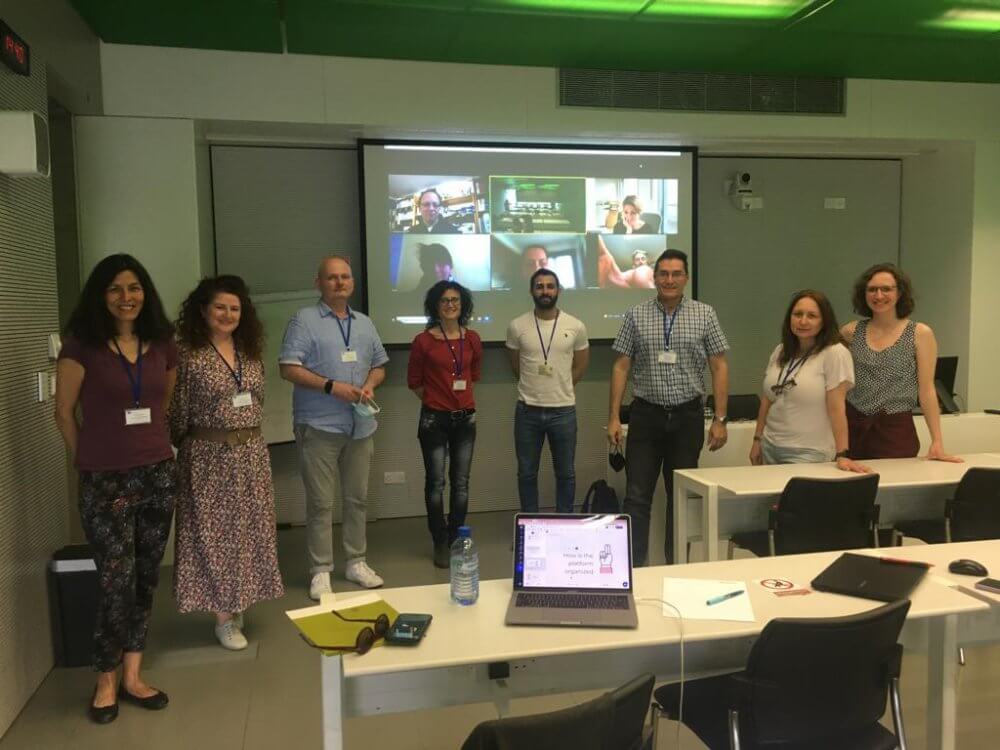
The 5th transnational project meeting was held in the University of Cyprus in Nicosia, Cyprus, between April 4-6, 2022. Representatives of the partner institutions from Germany, Poland, Spain, Israel and Cyprus took part in the gathering. Israel was represented by Regina Benchetrit and Inna Smirnov.

There were several items on the meeting’s agenda. One of the purposes of the meeting was to finalize the TOOLS learning platform and to launch it, including the E-learning course and the blended-learning course. In addition, the meeting focused on quality assurance and on incorporation of the external evaluator’s recommendations into the course modules.

Dissemination of the course and sustainability plan was discussed at length.

At the end of the meeting the partners discussed the final conference to take place in Opole in June 2022.

Presentations and publications about the project we elaborated as well.

Participation at the International Forum of Children's Development in China

Kaye College Faculty Members Participation at the China Soong Ching Ling Foundation International Forum on Children’s Development

 November 2020

Soong Ching Ling International Forum on Children’s Development was successfully held in Beijing on November 19-20, 2020.  The Forum was co-sponsored by China Soong Ching Ling Foundation and China Welfare Association, undertaken by China Soong Ching Ling Youth Cultural Exchange Center.  The Forum was supported by the UNICEF China Office, the Chinese and Foreign Cultural Exchange Center of the Ministry of Education, and the Beijing Municipal Education Commission.  The Forum set up the main venue at the China Soong Ching Ling Youth Cultural Exchange Center.

Close to one hundred experts, scholars, and educators from Beijing, Tianjin, Shanghai, Guangxi province, and Pengyang County of Ningxia province which is the designated place of the anti-poverty scheme by the China Soong Ching Ling Foundation, had attended the Forum.  Experts, scholars, and educators from Uzbekistan, the United Kingdom, Finland, Sweden, and Switzerland participated online in exchanges and seminars on the theme of “creating future children’s education and sustainable development.”

The Forum additionally presented a collection of 15 academic research papers from Israeli scholars and domestic scholars. One of these papers, titled “Learning from Screen Media in Early Childhood: A Double-Edged Sword,” was written by Kaye College professor, Dr. Yehuda Bar-Lev, together with his colleague, Prof. Nelly Elias from Ben Gurion University.

Visit to the HTH School Network in San Diego, California, USA. 2018

By:   Ms. Asnat Kleiman

On  the eve of Sukkot, I left as a representative of Kay College with a delegation to visit the HTH school network in San Diego and its environs.

Upon arrival we settled in a pleasant tourist complex for the duration of the visit. Near the compound are schools of the chain ranging from kindergarten to high school scattered throughout the neighborhood and a short walk away. Other schools are located between San Diego and Los Angeles, and the other is in Chula Vista, a Mexican border town near the city of Tijuana.

The delegation dealt with several levels; The first is a multicultural acquaintance between the members of the delegation and the teachers working on the HTH network; The second was the teaching-learning method that we constantly develop on the Internet and the influence we have as teachers; The third focuses on various collaborations, such as collaborations between the teams, the initiatives, with other schools, the development of community schools around the world, and in the United States in particular.

One of the schools that touched my heart was the school on the Mexican border – Chula Vista. Every day children come to the school on foot, from neighboring Mexico, and do not give up. Some return home at night. The school deals with immigration authorities and yet with children who come from different families, so that multiculturalism is not foreign to them. The children learn Spanish and English. The principal and some of the school staff, graduates of the schools in the area returned to work in schools, to return to the community and nurture it through a new generation of students.

I was interested in a pedagogical instructor in training teaching students, in the new teachers and in their acceptance of the staff. All of the new teachers are assigned mentors in parallel to the class or profession, in order to support and teach the way they work in the school, and some of the teachers come without training and receive it while they work, some of them coming from different backgrounds and professions. The book is a private body, yet it champions multiculturalism and tries to enable students whose economic, social and language abilities do not allow access to school.

Another emphasis was cooperation. During our visits we met many friends who came with us from Israel and we have already discussed ideas for cultural and inter-regional partnerships. Besides, we met teachers from schools and other places who came to learn and get to know partners. I met a friend from a school in Brooklyn, New York, who was taking his first steps in the community. I met with other teachers from the first elementary school, in the second grade who told about her acceptance to the staff, and another veteran teacher from the fourth grade who patiently answered our questions. We promised to keep the connection of the bush even from a distance.

Second Visit to Wuhan University , China

By:   Ms. Asnat Kleiman

On  the eve of Sukkot, I left as a representative of Kay College with a delegation to visit the HTH school network in San Diego and its environs.

Upon arrival we settled in a pleasant tourist complex for the duration of the visit. Near the compound are schools of the chain ranging from kindergarten to high school scattered throughout the neighborhood and a short walk away. Other schools are located between San Diego and Los Angeles, and the other is in Chula Vista, a Mexican border town near the city of Tijuana.

The delegation dealt with several levels; The first is a multicultural acquaintance between the members of the delegation and the teachers working on the HTH network; The second was the teaching-learning method that we constantly develop on the Internet and the influence we have as teachers; The third focuses on various collaborations, such as collaborations between the teams, the initiatives, with other schools, the development of community schools around the world, and in the United States in particular.

One of the schools that touched my heart was the school on the Mexican border – Chula Vista. Every day children come to the school on foot, from neighboring Mexico, and do not give up. Some return home at night. The school deals with immigration authorities and yet with children who come from different families, so that multiculturalism is not foreign to them. The children learn Spanish and English. The principal and some of the school staff, graduates of the schools in the area returned to work in schools, to return to the community and nurture it through a new generation of students.

I was interested in a pedagogical instructor in training teaching students, in the new teachers and in their acceptance of the staff. All of the new teachers are assigned mentors in parallel to the class or profession, in order to support and teach the way they work in the school, and some of the teachers come without training and receive it while they work, some of them coming from different backgrounds and professions. The book is a private body, yet it champions multiculturalism and tries to enable students whose economic, social and language abilities do not allow access to school.

Another emphasis was cooperation. During our visits we met many friends who came with us from Israel and we have already discussed ideas for cultural and inter-regional partnerships. Besides, we met teachers from schools and other places who came to learn and get to know partners. I met a friend from a school in Brooklyn, New York, who was taking his first steps in the community. I met with other teachers from the first elementary school, in the second grade who told about her acceptance to the staff, and another veteran teacher from the fourth grade who patiently answered our questions. We promised to keep the connection of the bush even from a distance.

Visit to Opole University, Poland

By:   Ms. Asnat Kleiman

On  the eve of Sukkot, I left as a representative of Kay College with a delegation to visit the HTH school network in San Diego and its environs.

Upon arrival we settled in a pleasant tourist complex for the duration of the visit. Near the compound are schools of the chain ranging from kindergarten to high school scattered throughout the neighborhood and a short walk away. Other schools are located between San Diego and Los Angeles, and the other is in Chula Vista, a Mexican border town near the city of Tijuana.

The delegation dealt with several levels; The first is a multicultural acquaintance between the members of the delegation and the teachers working on the HTH network; The second was the teaching-learning method that we constantly develop on the Internet and the influence we have as teachers; The third focuses on various collaborations, such as collaborations between the teams, the initiatives, with other schools, the development of community schools around the world, and in the United States in particular.

One of the schools that touched my heart was the school on the Mexican border – Chula Vista. Every day children come to the school on foot, from neighboring Mexico, and do not give up. Some return home at night. The school deals with immigration authorities and yet with children who come from different families, so that multiculturalism is not foreign to them. The children learn Spanish and English. The principal and some of the school staff, graduates of the schools in the area returned to work in schools, to return to the community and nurture it through a new generation of students.

I was interested in a pedagogical instructor in training teaching students, in the new teachers and in their acceptance of the staff. All of the new teachers are assigned mentors in parallel to the class or profession, in order to support and teach the way they work in the school, and some of the teachers come without training and receive it while they work, some of them coming from different backgrounds and professions. The book is a private body, yet it champions multiculturalism and tries to enable students whose economic, social and language abilities do not allow access to school.

Another emphasis was cooperation. During our visits we met many friends who came with us from Israel and we have already discussed ideas for cultural and inter-regional partnerships. Besides, we met teachers from schools and other places who came to learn and get to know partners. I met a friend from a school in Brooklyn, New York, who was taking his first steps in the community. I met with other teachers from the first elementary school, in the second grade who told about her acceptance to the staff, and another veteran teacher from the fourth grade who patiently answered our questions. We promised to keep the connection of the bush even from a distance.

Staff Visit to Opole University, Poland

By:   Ms. Asnat Kleiman

On  the eve of Sukkot, I left as a representative of Kay College with a delegation to visit the HTH school network in San Diego and its environs.

Upon arrival we settled in a pleasant tourist complex for the duration of the visit. Near the compound are schools of the chain ranging from kindergarten to high school scattered throughout the neighborhood and a short walk away. Other schools are located between San Diego and Los Angeles, and the other is in Chula Vista, a Mexican border town near the city of Tijuana.

The delegation dealt with several levels; The first is a multicultural acquaintance between the members of the delegation and the teachers working on the HTH network; The second was the teaching-learning method that we constantly develop on the Internet and the influence we have as teachers; The third focuses on various collaborations, such as collaborations between the teams, the initiatives, with other schools, the development of community schools around the world, and in the United States in particular.

One of the schools that touched my heart was the school on the Mexican border – Chula Vista. Every day children come to the school on foot, from neighboring Mexico, and do not give up. Some return home at night. The school deals with immigration authorities and yet with children who come from different families, so that multiculturalism is not foreign to them. The children learn Spanish and English. The principal and some of the school staff, graduates of the schools in the area returned to work in schools, to return to the community and nurture it through a new generation of students.

I was interested in a pedagogical instructor in training teaching students, in the new teachers and in their acceptance of the staff. All of the new teachers are assigned mentors in parallel to the class or profession, in order to support and teach the way they work in the school, and some of the teachers come without training and receive it while they work, some of them coming from different backgrounds and professions. The book is a private body, yet it champions multiculturalism and tries to enable students whose economic, social and language abilities do not allow access to school.

Another emphasis was cooperation. During our visits we met many friends who came with us from Israel and we have already discussed ideas for cultural and inter-regional partnerships. Besides, we met teachers from schools and other places who came to learn and get to know partners. I met a friend from a school in Brooklyn, New York, who was taking his first steps in the community. I met with other teachers from the first elementary school, in the second grade who told about her acceptance to the staff, and another veteran teacher from the fourth grade who patiently answered our questions. We promised to keep the connection of the bush even from a distance.

A Trip by the Master’s Degree Program Staff to the University of Bristol in the United Kingdom

By:   Ms. Asnat Kleiman

On  the eve of Sukkot, I left as a representative of Kay College with a delegation to visit the HTH school network in San Diego and its environs.

Upon arrival we settled in a pleasant tourist complex for the duration of the visit. Near the compound are schools of the chain ranging from kindergarten to high school scattered throughout the neighborhood and a short walk away. Other schools are located between San Diego and Los Angeles, and the other is in Chula Vista, a Mexican border town near the city of Tijuana.

The delegation dealt with several levels; The first is a multicultural acquaintance between the members of the delegation and the teachers working on the HTH network; The second was the teaching-learning method that we constantly develop on the Internet and the influence we have as teachers; The third focuses on various collaborations, such as collaborations between the teams, the initiatives, with other schools, the development of community schools around the world, and in the United States in particular.

One of the schools that touched my heart was the school on the Mexican border – Chula Vista. Every day children come to the school on foot, from neighboring Mexico, and do not give up. Some return home at night. The school deals with immigration authorities and yet with children who come from different families, so that multiculturalism is not foreign to them. The children learn Spanish and English. The principal and some of the school staff, graduates of the schools in the area returned to work in schools, to return to the community and nurture it through a new generation of students.

I was interested in a pedagogical instructor in training teaching students, in the new teachers and in their acceptance of the staff. All of the new teachers are assigned mentors in parallel to the class or profession, in order to support and teach the way they work in the school, and some of the teachers come without training and receive it while they work, some of them coming from different backgrounds and professions. The book is a private body, yet it champions multiculturalism and tries to enable students whose economic, social and language abilities do not allow access to school.

Another emphasis was cooperation. During our visits we met many friends who came with us from Israel and we have already discussed ideas for cultural and inter-regional partnerships. Besides, we met teachers from schools and other places who came to learn and get to know partners. I met a friend from a school in Brooklyn, New York, who was taking his first steps in the community. I met with other teachers from the first elementary school, in the second grade who told about her acceptance to the staff, and another veteran teacher from the fourth grade who patiently answered our questions. We promised to keep the connection of the bush even from a distance.

Staff Visit to Wuhan, China

During September 2017 two faculty members from Kaye College, Ms. Dina Ben Yaish, Head of the Program of Teacher Education for Kindergartens, and Ms. Barbie Shapir, Lecturer and Pedagogical Advisor in the Program of Teacher Education for Kindergartens, visited “Hamood” playgroup centers in Wuhan, China.

In China, organized early childhood education begins at age 3 and is run until the age of 6. The government licenses private daycare centers to operate playgroups for children starting from the age of six months and up to the age of 3.

One group has established such playgroup centers in the city of Wuhan, under the name “Hamood”. They hope to incorporate full daycare centers into this framework as well.

The professional relationship between Kaye College’s early childhood education training program and the “Hamood” centers was forged in order to develop programs in the fields of mathematics, science and crafts that will be run in the various playgroups. An additional objective is the development of continuing education programs for the educational staffs running these centers.

Beginning in April 2017, we started developing the continuing education programs and writing lesson plans on various subjects, tailored for preschool children. The group of initiators from China invited us on a scouting trip to see the operations at the “Hamood” centers firsthand, learn how they are run and how we can contribute, so that we could develop appropriate lesson plans.

The “Hamood” centers are interested in presenting a unique edge in their operations by focusing on Jewish values such as: helping others, respecting and preserving the environment, family values, maximal development of the individual’s talents, creativity, the ability to explore freely, honoring one’s parents, perseverance, connection to cultural traditions , and adopting a famous saying by one of our sages, Maimonides, that one must live by – “having a healthy soul will contribute to having a healthy body.”

Visit to University of Opole, Poland

During September 2017 two faculty members from Kaye College, Ms. Dina Ben Yaish, Head of the Program of Teacher Education for Kindergartens, and Ms. Barbie Shapir, Lecturer and Pedagogical Advisor in the Program of Teacher Education for Kindergartens, visited “Hamood” playgroup centers in Wuhan, China.

In China, organized early childhood education begins at age 3 and is run until the age of 6. The government licenses private daycare centers to operate playgroups for children starting from the age of six months and up to the age of 3.

One group has established such playgroup centers in the city of Wuhan, under the name “Hamood”. They hope to incorporate full daycare centers into this framework as well.

The professional relationship between Kaye College’s early childhood education training program and the “Hamood” centers was forged in order to develop programs in the fields of mathematics, science and crafts that will be run in the various playgroups. An additional objective is the development of continuing education programs for the educational staffs running these centers.

Beginning in April 2017, we started developing the continuing education programs and writing lesson plans on various subjects, tailored for preschool children. The group of initiators from China invited us on a scouting trip to see the operations at the “Hamood” centers firsthand, learn how they are run and how we can contribute, so that we could develop appropriate lesson plans.

The “Hamood” centers are interested in presenting a unique edge in their operations by focusing on Jewish values such as: helping others, respecting and preserving the environment, family values, maximal development of the individual’s talents, creativity, the ability to explore freely, honoring one’s parents, perseverance, connection to cultural traditions , and adopting a famous saying by one of our sages, Maimonides, that one must live by – “having a healthy soul will contribute to having a healthy body.”

Visits to Schools Overseas

The School for Advanced Studies is currently organizing trips for the students and lecturers to visit University of Bristol in England and University of Tampere in Finland. The purpose of these visits is to become familiar with the educational system (by visiting the university, schools and study centers) and to speak with the faculty members and education students pursuing a Master’s degree.

M.Ed. Group's visit to Tampere University, Finland

The School for Advanced Studies is currently organizing trips for the students and lecturers to visit University of Bristol in England and University of Tampere in Finland. The purpose of these visits is to become familiar with the educational system (by visiting the university, schools and study centers) and to speak with the faculty members and education students pursuing a Master’s degree.

The English Department Group's visit to Opole University, Poland

The School for Advanced Studies is currently organizing trips for the students and lecturers to visit University of Bristol in England and University of Tampere in Finland. The purpose of these visits is to become familiar with the educational system (by visiting the university, schools and study centers) and to speak with the faculty members and education students pursuing a Master’s degree.

The Shachaf Group's visit to Leiden University, The Netherlands

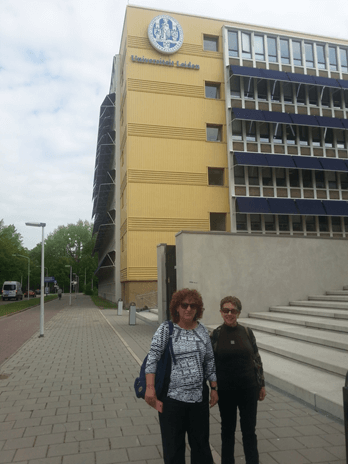
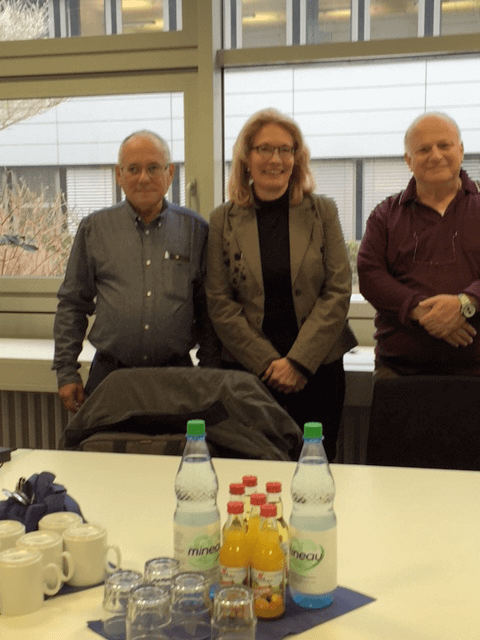
Members of the Shachaf group, Dr. Yehudit Barak and Dr. Smadar Tuval, visited Leiden University in the Netherlands at the end of May of 2015. Specifically, they visited the multidisciplinary institute of training, teaching and professional development for teachers at schools and institutions of higher education – ICLON. The training program that the group attended is at the Master’s degree level and is open to university graduates.

The group was hosted by Professor Mandi Berry, who leads the self-study approach as a central method of study and development in teacher education. She is the coeditor of a journal entitled Studying Teacher Education, which collects studies on this topic. During the three-day visit, the group learned about the various teacher education programs and about the educational system in the Netherlands. They met with Professor Jan van Driel, head of ICLON, and Dr. Annemarie Thompson, head of the Department of Teacher Training at the institution.

The group also visited a bilingual high school (English and Dutch) in Rotterdam that maintains professional relations with the teachers training program and Leiden University. Dr. Barak and Dr. Tuval sat in on lessons, met with teachers and the school principal, and learned that in the Netherlands, each child’s future course of study is determined at the age of 12 – either vocational studies or university studies.

The discussions that were held throughout the visit were interesting and productive and resulted in a possible collaboration plan related to teacher training, with an emphasis on dealing with diversity and multicultural elements. The option of online collaboration was examined, as well as submission of a proposal for a joint project as part of the Erasmus+ project.

The Shachaf Group's visit to Leiden University, Holland

The Educational Induction Unit Group's visit to Exeter University, UK

The Shachaf Group's visit to Leiden University, Holland

The Early Childhood Education Program Group's visit to HAN PABO University, Holland

The Shachaf Group's visit to Leiden University, Holland

The English Department Group's visit to York St. John University, UK

As part of the development of international relations in Tempus Iris Project, three representatives of Kaye College, Dr. Liron Shokty, Head of The Office of International Academic Relations and a lecturer in the English Department, Ms. Regina Benchetrit, Head of the Center for Students with Special Academic Needs and lecturer in the English Department , and Dr. Inna Smirnov, Head of the English Department and Head of the Junior-High School Training Program, visited York St. John University in York, England during January 2016, in order to attend the annual conference “Talking About Teaching” and to consolidate and further develop the existing academic collaboration.

During the visit several meetings with university faculty were held in which it was agreed on the continuation and expansion of the collaboration between the Department of Theology and Education at St. John University and Kaye College students majoring in English. Both parties also agreed on launching a joint research and the possibility of student mobility.

In summary, the visit was fruitful and both sides expressed a desire and willingness to continue and deepen academic collaboration between the institutions.

Visit to The Graduate School of Education at the University of Bristol, UK

As part of the development of international relations in Tempus Iris Project, three representatives of Kaye College, Dr. Liron Shokty, Head of The Office of International Academic Relations and a lecturer in the English Department, Ms. Regina Benchetrit, Head of the Center for Students with Special Academic Needs and lecturer in the English Department , and Dr. Inna Smirnov, Head of the English Department and Head of the Junior-High School Training Program, visited York St. John University in York, England during January 2016, in order to attend the annual conference “Talking About Teaching” and to consolidate and further develop the existing academic collaboration.

During the visit several meetings with university faculty were held in which it was agreed on the continuation and expansion of the collaboration between the Department of Theology and Education at St. John University and Kaye College students majoring in English. Both parties also agreed on launching a joint research and the possibility of student mobility.

In summary, the visit was fruitful and both sides expressed a desire and willingness to continue and deepen academic collaboration between the institutions.

A Visit to Carl von Ossietzky University of Oldenburg, Germany

During January of 2016, two faculty members, Prof. Shlomo Back and Dr. Amnon Glassner visited Carl von Ossietzky University of Oldenburg in Germany to discuss the topic of Heutagogy and to explore possible ways for collaboration.

While visiting they met with various key members of faculty: with Prof. Dr. Barbara Moschner, the Head of Teacher Education at Carl von Ossietzky University of Oldenburg; with Lisa Marie Blaschke, the Program Director of the MDE; with Prof. Dr. Olaf Zawacki-Richter, director of the Center for Lifelong Learning and a lecturer in the School of Education and Social Sciences and with Tim Zenter, coordinator of M.A. program in lifelong learning.

Together with Prof. Dr. Barbara Moschner both parties decided to continue to increase research and practical connections mainly concern to some of our common challenges such as teacher education for learning and instruction in multicultural environment (e.g. the new refugees) and promoting of new teaching directions in teacher education programs which will be more suitable to the 21st century learners needs (e.g. Heutagogy, PBL).

It was also decided to continue to strengthen research and practical connections to promote self determination learning (Heutagogy), in face to face and in distant learning, agreeing that heutagogy is as a very relevant learning and teaching approach among students and lecturers in higher education and among pupils and teachers in schools, aiming to answer the new learners’ needs and to cope with the global society challenges.

Another decision was to expand the academic connections between the lifelong learning department at Oldenburg University and some of the departments and schools in Kaye academic college of education (e.g. the lifelong learning school for teachers; the informal learning studies).

A Visit to Carl von Ossietzky University of Oldenburg, Germany

Let's Talk

We are here to answer any questions.

Details & registration

Skip to content